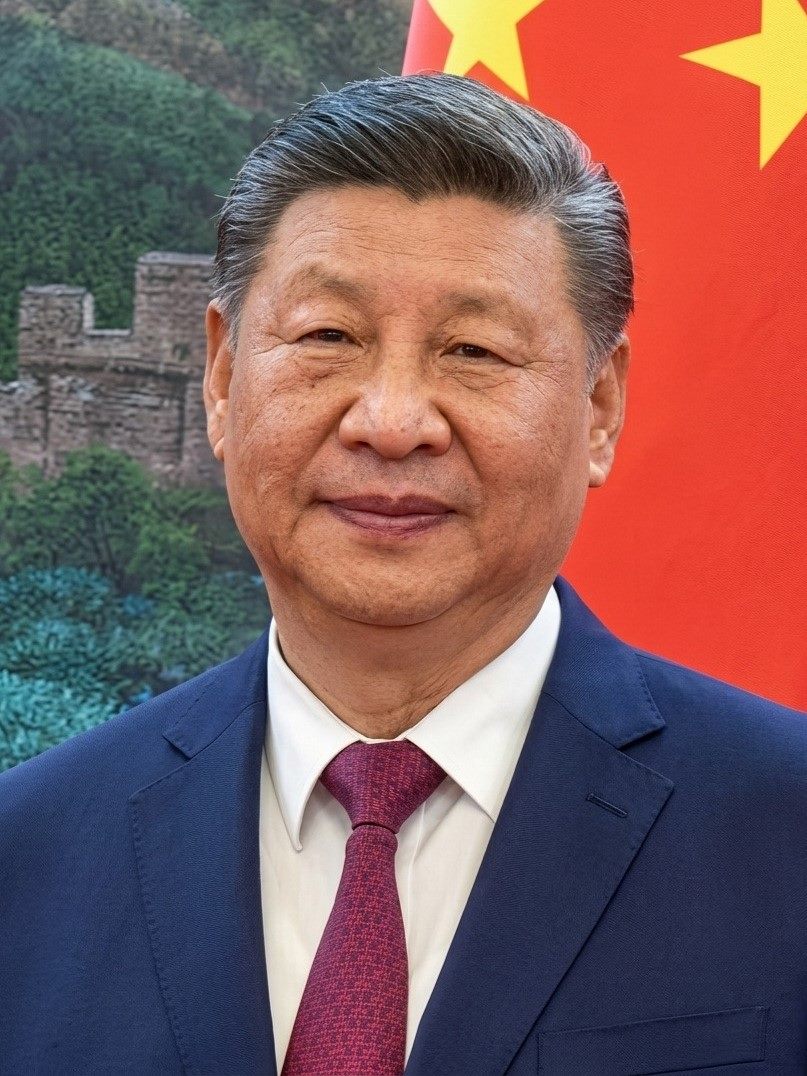
Chinese President Xi Jinping, Russian President Vladimir Putin and US President Donald Trump held their first three-way summit in Shenzhen on Nov. 19, issuing a peace declaration covering dialogue on nuclear risk reduction and non-proliferation, UN reform and stable energy supplies. Xi set out four views on how major powers should get along, and China’s foreign minister said stronger communication among major powers “meets the world’s expectations.”
The leaders of China, Russia and the United States sat down together on the afternoon of Nov. 19 in Shenzhen, Guangdong province, where the Asia-Pacific Economic Cooperation (APEC) leaders’ meeting was under way. According to Xinhua and Global Times’ Huanqiu site, the meeting was chaired by Xi and marked the first time the three heads of state had met in a trilateral format. Kyunghyang Shinmun and the Associated Press reported that the talks ran about 90 minutes at Kylin Villa (Qilin Shanzhuang), Shenzhen’s state guesthouse, with Trump and Xi seated first before Putin joined and Xi taking the middle seat. Beijing framed the theme as “safeguarding world peace and promoting strategic stability in major-country relations.”
광고 문의 · 300×250The “China-Russia-US Heads of State Peace Declaration” released by Xinhua after the talks has four main strands. First, the three permanent members of the UN Security Council committed to reforming the United Nations so it can better fulfil its duty to maintain international peace and security. Second, they plan to increase production and supply of refined petroleum products and reaffirmed the importance of stable energy flows. Third, they affirmed the principle of state consent and the importance of immunity for state officials, agreeing that the International Criminal Court (ICC) and similar bodies should not abuse their jurisdiction.
The fourth and most closely watched strand concerns nuclear weapons. According to Fox News and Al Jazeera, the leaders reaffirmed that “a nuclear war cannot be won and must never be fought” and pledged dialogue on reducing nuclear risks and preventing proliferation. The White House issued the same text under the title “U.S.-Russia-China Heads of State Declaration toward Peace.” Kyunghyang Shinmun noted, however, that Washington has long insisted China be included in any successor to the New START treaty while Beijing has remained reluctant, so no concrete arms-control framework has yet been set.
Xi’s four views on major-power coexistence
According to Xinhua, Xi offered four views on how major countries should get along. The first is “mutual respect”: respecting sovereignty and territorial integrity, each other’s social systems, development paths and core interests, and consulting in advance on sensitive issues so as not to cross each other’s red lines. The second is “peaceful coexistence”: Xi said the “Thucydides Trap” is not destiny and that the three countries should be partners rather than rivals locked in conflict or confrontation. He also stressed upholding the UN Charter, the post-war international order and the outcomes of the victory in World War II, as well as compliance with the Treaty on the Non-Proliferation of Nuclear Weapons (NPT).
The third is “win-win cooperation.” Xi said the three countries’ strengths in resources, manufacturing and consumption are complementary, urging them to discard a Cold War mentality and enlarge economic and trade cooperation while opposing “decoupling and severing supply chains.” The fourth is “dialogue and consultation”: he proposed regular high-level exchanges, open channels at every level and a mechanism for crisis communication and prevention. He added that the three countries should encourage parties to conflicts to come to the negotiating table and resolve disputes through political and diplomatic means.
The other two leaders also spoke highly of the outcome. Al Jazeera reported Trump as saying “three of the world’s largest nations” had gathered and “We’re making history,” while Kyunghyang Shinmun said he spoke of the three countries’ “special responsibility” to keep talking about world affairs. Putin said the discussion was “very frank” and helped the leaders understand one another better, and according to the AP he remarked as Xi saw him to his car that nobody could have expected things to go so well. The Kremlin said Ukraine was not the central topic of the trilateral session.
China’s foreign minister described the gathering as a “peace summit” at a press conference that night at the APEC media centre in Shenzhen. Taiwan’s Central News Agency and Liberty Times reported that the briefing was postponed twice because he was seeing the two visiting leaders off at the airport, finally starting around 10:05 p.m. He said that as the world changes rapidly and risks grow, international calls for major powers to communicate and coordinate are rising, and that the meeting “is in line with the trend of the times and the world’s expectations.” He added that the three leaders had explained their strategic intentions face to face, agreed to prevent conflict and confrontation, and would keep in touch through working-level channels.
Inside and outside the venue: the nuclear briefcase, Kylin Villa and an absent Kim Jong Un
According to Kyunghyang Shinmun, Kylin Villa is a state guesthouse of some 380,000 square metres built for diplomatic events ahead of Hong Kong’s 1997 handover. Xi’s father, former Vice Premier Xi Zhongxun, convalesced there for several months after a cancer diagnosis in 2002 before his death, and North Korea’s then leader Kim Jong Il stayed there during a 2006 visit to Shenzhen. Security was tightened sharply, with police controlling nearby roads and local tourist sites closed. Bloomberg reported that the Russian delegation brought the so-called nuclear briefcase, and Kyunghyang said Putin kept it close throughout his two days in Shenzhen.
From the Korean Peninsula’s perspective, the most notable absence was North Korean leader Kim Jong Un. Trump said on Nov. 16 that he might meet Kim in China, but North Korean state media reported that Kim was on field guidance in Ryongwon and Rakwon counties in South Hamgyong province on Nov. 17-18. Kyunghyang cited Pyongyang’s desire to be recognised as a nuclear state, the US State Department’s Nov. 18 reaffirmation of “complete denuclearization,” and closer North Korea-China-Russia ties that reduce Pyongyang’s need for talks with Washington. As at last year’s APEC in Gyeongju, no Trump-Kim meeting materialised in Shenzhen.
Trump headed straight to the airport after the talks and flew home. According to United Daily News and the Central News Agency, he phoned Japanese Prime Minister Sanae Takaichi from the presidential plane for about 20 minutes to brief her on the trilateral summit and his talks with Xi. Takaichi told reporters she had received a detailed explanation and had frankly exchanged views on international issues including the Indo-Pacific and Ukraine. Taiwanese media reported that Trump is scheduled to hold a press conference at the White House on Nov. 20.
A third perspective
Reactions to the declaration differ by country. Euronews reported that even before the summit there were fears the three powers might carve out spheres of influence and make decisions about Ukraine or Europe without them, and Germany hosted a “Coalition of the Willing” meeting of Ukraine’s backers the same day. European outlets also noted that the declaration makes no direct reference to the wars in Ukraine or Iran. Kyunghyang Shinmun reported that while the meeting opened the door to great-power dialogue, it also drew assessments that “multilateralism is fading,” citing analysis that Russia, emerging from international isolation, and host China gained more symbolically. Beijing, for its part, stresses that the meeting is a “historic, landmark event” that contributes to world peace by stabilising major-power relations.
In Japan, United Daily News reported, concern grew after the Trump-Takaichi meeting was cut to a brief chat that the US, China and Russia might settle major matters without Tokyo. Taiwan’s Executive Yuan spokesperson Li Hui-chih said on the day that the government views positively any effort that helps regional risk management and security, that Taipei is in close contact with Washington, and that its position of “maintaining the status quo and ensuring peace and stability” is unchanged. South Korea’s presidential office said before the summit that the peninsula was unlikely to be a main topic but that Seoul had conveyed its position to all three, and Fox News reported that China’s readout listed the Korean Peninsula alongside Ukraine and the Middle East on the agenda.
The summit matters for the ethnic Chinese community in South Korea as well. Stability in China-US relations and crisis-communication channels among major powers add predictability for overseas Chinese business owners whose livelihoods depend on Korea-China trade and travel. Yet with US-North Korea dialogue again failing to materialise, the path to easing tension on the peninsula remains unfinished, and it remains to be seen how the energy-supply pledge will feed through to oil prices and living costs. The Group of 20 summit in Miami next month is expected to be the first test of whether this “Shenzhen moment” turns into practical cooperation.