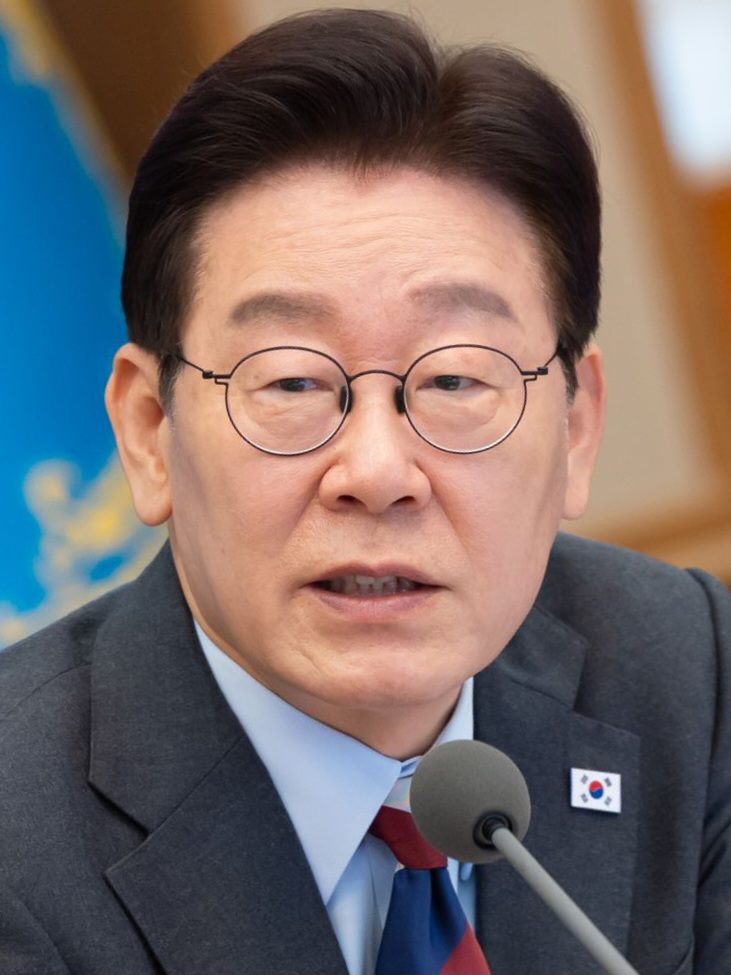
President Lee Jae-myung hosted Democratic Party leader Kim Min-seok, floor leader Han Byung-do and other party leaders at Cheong Wa Dae on Wednesday, urging the party and government to move with one heart and one mind. The most contentious issue, the comprehensive real estate tax deduction for non-resident single-home owners, reportedly did not come up.
According to the Kyunghyang Shinmun, Lee dined with the ruling party leadership at Cheong Wa Dae from 6:30 p.m. to 9:20 p.m. on November 11. Attending from the Democratic Party were Kim Min-seok, Han Byung-do, senior deputy floor leader Chun Jun-ho and Kim Tae-sun, chief of staff to the party leader; chief of staff Im Kwang-hyun and senior political secretary Choi In-ho joined from the presidential office. It was the first such dinner in 78 days, since Lee invited the leadership right after Kim was elected party leader on August 25.
광고 문의 · 300×250According to a written briefing by senior spokesperson Kang Yu-jung, Lee asked for the National Assembly's cooperation in passing next year's budget, saying the party and government 'must move with one heart and one mind so that people's lives can improve.' He told Im and Choi to communicate closely with the legislature. Kim asked the government to come up with bold and swift measures to overcome polarization and boost consumption.
'Not mentioned at all': the presidential office holds its line
The dinner drew attention because it came amid a rift between the party and the presidential office over the property tax deduction for non-resident single-home owners. A senior presidential official, however, said the tax was not discussed at all. In its August tax reform plan, the government raised the deduction for owner-occupiers from 1.2 billion won to 1.4 billion won and cut it for non-resident owners to 900 million won; a month later, at the party leadership's request, the non-resident figure was restored to 1.2 billion won.
The dispute surfaced at a high-level party-government meeting on November 8, when some Seoul lawmakers demanded that the non-resident deduction also be unified at 1.4 billion won. A presidential official said that since the owner-occupier deduction had already been raised to 1.4 billion won and the non-resident one lifted once from 900 million to 1.2 billion won, further relief would be difficult, adding that this reflected the president's view. Deputy Prime Minister for the Economy Lee Hyung-il told the parliamentary budget committee on November 10 that treating owner-occupied and non-resident homes the same would violate the principle of a residence-centered market, NewDaily reported.
Ruling party divided; analysis says benefits would go to Gangnam and 'Ma-Yong-Seong'
Opinion within the party is split. The Kyunghyang Shinmun reported that a research group on rental stability, including Reps. Lee Un-ju, Hwang Hee, Lee Su-jin and Kim Jun-hyeok, held a forum arguing that taxing homes differently by residence could shrink jeonse listings and push up rents. On the other side, former party leader Chung Chung-rae wrote on Facebook that the government's owner-occupier priority must be upheld, and Supreme Council member Choi Min-hee objected that the thresholds had already been adjusted at the party's request and asked why the party would shake the government's reform. Some lawmakers also said a 1.4 billion won threshold was unrealistic outside Seoul.
Smaller parties in the broader ruling camp and civic groups have also voiced opposition. At a National Assembly press conference on November 10, the office of Rep. Cha Kyu-geun of the Rebuilding Korea Party released an analysis finding at least about 57,000 non-resident single homes in Seoul with an assessed value of 1.2 billion won or more, and said about 85 percent of the benefit of raising the deduction to 1.4 billion won would go to the three Gangnam districts and Mapo, Yongsan and Seongdong. Floor leaders of the Progressive Party and the Social Democratic Party and groups including People's Solidarity for Participatory Democracy joined the event, and civic groups criticized the idea as a tax cut for the rich.
According to a senior Democratic Party official, Kim does not want further easing, noting that the government's original plan was drawn up while he was prime minister. Han is also said to be likely to favor settling at the level of the first revision agreed between the party and the government. Observers say Lee's decision not to raise the issue at the dinner could be read as a signal to avoid public debate and keep the existing principle.
Ethnic Chinese households in Seoul and the capital region who own homes would do well to watch how this debate ends. Those who do not live in their own home because of work or children's schooling may be classified as non-resident single-home owners and face a different deduction threshold. Under the government plan, whether an owner actually lives in the home would be the key factor in the tax bill, so it is worth following the National Assembly's tax law review and checking residence requirements in advance.